

Welcome to the Transgender Resource Page! This guide is designed to help transgender and gender-diverse people find resources to make their transition go more smoothly and support them when things get tough. While this page contains some state-wide and national resources, it is largely focused on the Champaign-Urbana region of central Illinois. There are also resources here for clinicians who want to help transgender clients but don’t know where to start. This project is a labor of love, and the internet is always changing, so please, if you have suggestions for things to add, or a link on this page is broken, email me to let me know, and I’ll fix it as soon as possible!
I’m so glad you’re here, and before we jump in, I just want to remind you:
YOU ARE NOT ALONE!
If you feel helpless, hopeless, or trapped, please know that support is out there, starting right here. If you are in crisis, call 1-866-488-7386 or text 678678 to speak to a crisis counselor at The Trevor Project. You can also call the Champaign County Crisis Line at 1-217-359-4141.
If this is a medical emergency, please call 9-1-1!
for clients
Transitioning is a process, and can consist of a number of steps, depending on the individual person. These steps aren’t always the same for everyone, and not every trans or gender-diverse person chooses to do everything on this list. Remember—this is your transition, so what works for someone else may not be what you want, and that’s ok! Usually, all the components of an individual person’s transition fall into three broad categories: Social, Legal, and Medical/Health.
social resources
Some people think of social transitioning as the “easy” part, because there is no paperwork involved, no doctors, no therapists, etc. That said, transitioning socially includes things like picking a new name and pronouns, changing your clothing or hairstyle, deciding to wear or not wear makeup, and coming out to friends. There are a lot of choices involved—the trick is, you don’t have to choose or change everything at once, or anything at all if you don’t want to! Social transition can also be a period of exploration and figuring out who you really are.
For folks trying to decide on a name, you might be interested in this article. Again, when you’re first starting out, you may even try different names on for size and decide which one feels most like you.
Speaking of trying things on for size, sometimes changing clothing styles includes items like binders so you can safely bind your chest. I recommend checking out gc2b and Gender Gear, which are both trans-owned and operated companies that produce gender-affirming clothing items.
Transitioning socially can also feel really isolating if you don’t know many other people who feel like you. Many communities have an LGBTQ+ resource center like Uniting Pride that you can reach out to for events, support groups, and places that feel safe to go. For University of Illinois students, reach out to the Gender & Sexuality Resource Center, too!
If you need someone to talk to about transitioning and figuring out how to navigate it, looking for a therapist who provides gender-affirming care is really important. You can always start by checking out a resource like Psychology Today. If you click this link, you can see a list of clinicians in Champaign who work with transgender clients.
legal resources
One part of adopting a new name and gender presentation is often updating your legal documents to match your identity. For people who experience dysphoria, it can feel really awful to have to use a driver’s license, ID, or bank card with your birth name on it. The rules for changing these things are different depending on the State and sometimes the county where you live, but generally speaking, it involves filing some kind of paperwork at your county courthouse, attending a hearing, and then taking the signed court order to the places that issued your IDs.
Equality Illinois has a comprehensive Guide to Name and Gender Marker Changes that gives a lot of detail on the process, however the guide was written in 2013, and some things have changed in that time. For instance, in 2023, Illinois passed a law making it much easier to update the gender marker on your birth certificate! The instructions for this updated process are available through the Illinois Department of Public Health, though to update your name, you’ll still need to start with the steps in Equality Illinois’s guide. If you’re looking to change your name in Champaign County, you can start with the Request for Name Change packet for Adults or for Minor Children.
Another great place to look for legal information is the Transgender Law Center! They have information about all things transgender law, though they can’t provide individual legal advice. If you need help with a specific case, start with your state’s Bar Association, which usually has a directory of lawyers you can search, like this one from the Illinois Bar Association.
medical/health resources
Finding a healthcare provider can be really stressful. Luckily there are some resources that make that process easier. First, you can check out the World Professional Association for Transgender Health (WPATH) to find medical and mental health practitioners who are trained or certified to work with trans people. Here’s a link to their member directory. Of course, not every doctor, nurse, or counselor who works with trans folks is a WPATH member, so for folks in the Champaign-Urbana area, check out the Uniting Pride LGBTQ-Affirming Healthcare Practitioner Network.
Mental health is health! Don’t forget to check out that Psychology Today list if you’d like to find a counselor to work with. You can filter the list based on your insurance, and a lot of therapists have a sliding scale to help keep therapy affordable if you are uninsured or under-insured.
for clinicians
As mental health professionals, whether we are counselors, marriage and family therapists, social workers, or psychologists, it is important that we have the training to properly support our transgender and gender-diverse clients. Unfortunately, most of our graduate programs spend little to no time on these topics, which makes it all the more crucial for us to know where to seek additional guidance.

A wonderful place to start is the World Professional Association for Transgender Health, or WPATH. Founded in 1979 as the Harry Benjamin International Gender Dysphoria Association, WPATH is one of the oldest professional associations in continuous operation to support research and ongoing improvement of healthcare and quality of life for TGD individuals. The organization includes medical and mental health professionals, researchers, and policymakers working toward a goal of justice and equality in access to evidence-based healthcare and social services for people of all genders. They produce the International Journal of Transgender Health, formerly the International Journal of Transgenderism, a peer-reviewed academic journal published through Taylor & Francis, which seeks the latest research and policy. Most importantly, WPATH’s research leads to the Standards of Care for the Health of Transgender and Gender Diverse People, which is designed to be a global set of best practices for care, currently in its eighth edition, and available for free online.
In addition to the Standards of Care, WPATH also provides the Global Education Institute, which gives training specific to the SoC, and ongoing continuing education. WPATH members can seek certification in the current SoC by completing courses through the Institute along with completing other work with TGD individuals in their home communities.

The Affirmative Couch is an APA-approved Continuing Education sponsor that provides courses on working with TGD clients and their families, usually with fairly affordable prices for courses, and discounts for courses that are being discontinued. They offer courses on a variety of other topics, but if you are looking specifically for their materials on working with TGD clients, follow this link.
books
I also wanted to share a few books specifically for clinicians who are looking to dive deeper into working with TGD clients. This is by no means an exhaustive list, but a selection from my own clinician library to use as a starting point if you don’t know where to start. I am sharing them with links to their publisher sites, but most of them are available from major booksellers online or at brick-and-mortar stores (usually by special order). Click the book cover to go to the website. All descriptions provided by the publishers.

Queer Social Work: Cases for LGBTQ+ Affirmative Practice
edited by Tyler M. Argüello
This collection of case studies that model LGBTQ+ affirmative social work practice offers real-life scenarios from a range of social work scholars, educators, and practitioners, representing diverse sexualities, genders, and intersectional identities. Together, they demonstrate contemporary, multilevel, queer-affirming social work practice with LGBTQ+ people and communities.

Trans Sex: Clinical Approaches to Trans Sexualities and Erotic Embodiments
by Lucie Fielding
Despite the increasing visibility of trans and non-binary folx in media, political representation, and popular culture, their sexual lives and erotic embodiments are woefully under-attended-to in both scholarship and clinical practice. The aim of this book is to equip providers with both conceptual frameworks and concrete tools for better engaging their trans, non-binary, and gender expansive clients in pleasure-centered discussions of sexual health.
Challenging the dominant images of trans sexualities that appear in the existing literature, such as an emphasis on avoiding gender dysphoria, the preservation of sexual function, or on sexual losses that may arise as a result of transition pathways, Trans Sex offers a pleasure-positive approach to working with trans clients. Providing concrete clinical practices and practical activities that utilize social justice, intersectional trans feminism, and radical queer theory as key conceptual frameworks, this groundbreaking text is designed to be accessible to a wide range of providers. This book draws on Fielding’s experiences as both a trans client/patient and as a therapist to shift and expand the conversation and includes contributions from other trans and non-binary providers working at the intersection of gender-affirmative care and sexuality.
Trans Sex seeks to move trans sexualities from the margins of gender-affirmative clinical practice, to center pleasure, and to spark creativity and empathic attunement within the client-provider relationship. Whether they be mental health or medical providers, trainees, or seasoned practitioners in gender-affirmative work or sexualities, readers will be able harness creative strategies to enhance their practice and become more imaginative providers.
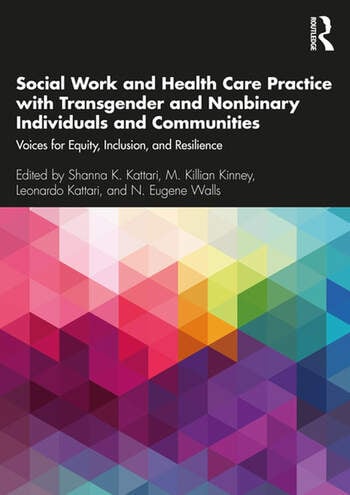
Social Work and Health Care Practice with Transgender and Nonbinary Individuals and Communities: Voices for Equity, Inclusion, and Resilience
edited by Shanna M. Kattari, M. Killian Kinney, Leonardo Kattari, N. Eugene Walls
This book examines issues across the lifespan of transgender and nonbinary individuals whilst synthesizing conceptual work, empirical evidence, pedagogical content, educational experiences, and the voices of transgender and nonbinary individuals. It highlights the resilience and resistance of transgender and nonbinary individuals and communities to challenge narratives relying on one-dimensional perspectives of risk and tragic lives.

Treating Trauma in Trans People: An Intersectional, Phase-Based Approach
by Reese Minshew
Treating Trauma in Trans People brings together key concepts from both gender-affirming treatment and trauma-focused care, with interventions focused on resolving physiological, intrapsychic, and interpersonal disruptions. Symptoms related to trauma and stress manifest in bodies, psyches, and interpersonal interactions. Gender, too, is impacted by bodies, psyches, and interpersonal interactions. With chapters that focus on each of these domains, this book provides a framework for clinicians eager to provide trauma-informed, gender-inclusive care. The book then broadens the lens to the systemic, acknowledging the limits of individual interventions when located within a larger framework of systemic oppression and asking clinicians to consider liberation and justice as treatment goals.

Social Work Practice with Transgender and Gender Expansive Youth
edited by Jama Shelton, Gerald P. Mallon
This fully revised third edition explores the childhood and adolescent experiences of transgender persons, providing foundational knowledge for social workers and related professions about working with trans and gender expansive youth.
Organized through the lens of four distinct forms of knowledge – knowledge of lived expertise, community-based knowledge, practice knowledge, and knowledge obtained through formal/traditional education – this text balances discussion of theory with a range of rich personal narratives and case studies. Updates and additions reflect recent changes to the WPATH guidelines and the NASW Code of Ethics, include brand new material examining the origins of gender identity and non-binary identities, explore intersectional identities, and offer expanded content considering trauma-informed interventions and ethical issues. Each featuring at least one trans or gender expansive author, chapters present concrete and practical recommendations to encourage competent and positive practice.
With a focus on both macro and micro social work practice, this book will be a valuable resource to any social service practitioners working with children or adolescents.

The Queer and Transgender Resilience Workbook: Skills for Navigating Sexual Orientation and Gender Expression*
by Anneliese A. Singh
*a note about this book: This workbook is designed for clients to use. However, there is a clinician guide, which can easily be adapted as a resource for clinicians to use as an intervention framework with clients.
Resilience is a key ingredient for psychological health and wellness. It’s what gives people the psychological strength to cope with everyday stress, as well as major setbacks. For many people, stressful events may include job loss, financial problems, illness, natural disasters, medical emergencies, divorce, or the death of a loved one. But if you are queer or gender non-conforming, life stresses may also include discrimination in housing and health care, employment barriers, homelessness, family rejection, physical attacks or threats, and general unfair treatment and oppression—all of which lead to overwhelming feelings of hopelessness and powerlessness. So, how can you gain resilience in a society that is so often toxic and unwelcoming?
In this important workbook, you’ll discover how to cultivate the key components of resilience: holding a positive view of yourself and your abilities; knowing your worth and cultivating a strong sense of self-esteem; effectively utilizing resources; being assertive and creating a support community; fostering hope and growth within yourself, and finding the strength to help others. Once you know how to tap into your personal resilience, you’ll have an unlimited well you can draw from to navigate everyday challenges.
 Daniel K. Sheff